Source-aligned data products, or output ports on the source?
Do source-aligned data products solve the problem, or do we instead need a more suitable output port on the source system.

When it comes to integrating data from upstream services, source-aligned data products are really no different to how we’ve always integrated data.
Data is still extracted by centralised/separate data engineering teams who have little understanding of the source systems and how the data is modelled.
The source-aligned data products are still designed to mirror the internal data structures of the source system, using tools like CDC or ELT, creating a tight coupling to those data structures and requiring deep knowledge of the source systems to use.
The owners of the source systems still have little or no knowledge or responsibility for these source-aligned data products, which means a lack of change management, no SLOs, and poor reliability.
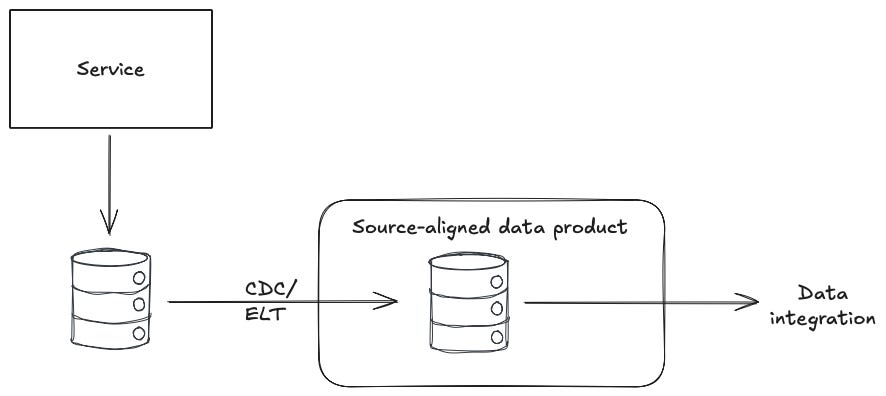
So, the same problems we had before, just renamed.
To solve these problems we need to move away from the assumption we need an extraction of data from source systems and towards the use of interfaces - or, as data mesh calls them, output ports - on the source system.
These source systems likely already provide an interface to support integrations with other systems - an API.
Many teams treat this API as a product that provides their consumers with:
Data models designed for easy consumption, that could/will be different from the underlying database
Loose coupling, so the source system can change without the API changing
Change management, through API versioning and backwards compatibility
Reliability and confidence, backed with SLOs
As the owners of the source system, they know exactly how best to build and operate this API and can take responsibility for providing and maintaining this product for their consumers.
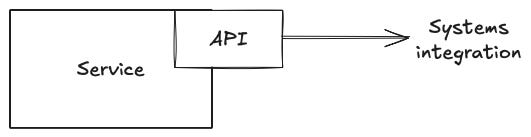
Unfortunately, we can’t easily build data integrations on these APIs, as they tend to support small amounts of data extraction and are modelled around individual records.
What we need is a different interface - a different output port - providing us with the data we need to meet our use cases.
Typically this would be an event stream and/or a regular write to the data warehouse, using a data contract for schema management.
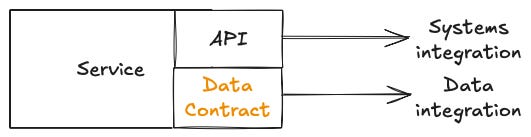
There are two reasons why source systems rarely provide this additional output port:
Data teams have for decades assumed the responsibility for building these extractions, with all the effort and poor results that come from it, because we assumed we couldn’t ask for anything different
The tools for systems owners to easily build these interfaces often don’t exist, and certainly are not of the same quality as the tools they have for building an API, which typically is just a bit of code for them to write with authorisation, observability, etc, provided by the platform
Solving that first problem requires a shift in mindset, and the realisation that we are creating something valuable enough to the company that we can ask for dependable inputs, just like other teams do.
The second problem requires investing in the data platform to provide the tooling that makes creating this data contract as easy as creating an API.
But if we can do those things we would make the source-aligned data products redundant, saving all that effort, avoiding all those issues, and improving the reliability and quality of our data integrations.
That’s an investment worth making.
Originally published at https://andrew-jones.com/newsletter/2025-10-17-source-aligned-data-products-or-output-ports-on-the-source/.
What strikes me about this conversation is that data contracts often get framed as a technical artefact, when the real value is behavioural. They force early clarification of meaning, ownership, and expectations.
In my experience, the health of data flow becomes visible when complexity reduces at the integration boundaries. Simplicity is the observable signal of value here — fewer downstream surprises, fewer compensating models, fewer reconciliation loops.
It’s interesting to see contracts shifting the cost of ambiguity back to where it’s cheapest to resolve, rather than downstream where it’s most expensive.
That feels like the systemic unlock.
This makes a lot of sense, but it think it’s tricky organizationally to get the source system team to see this as core work: to actively take on data dependencies by publishing by streams. They see the primary application work as their job, and downstream use cases as secondary things they allow but aren’t focused on. It’s a big shift to get them to see downstream use cases as core and worthy of capacity. I think we can overcome it with strategic alignment and leadership buy in but it’s a huge paradigm shift.